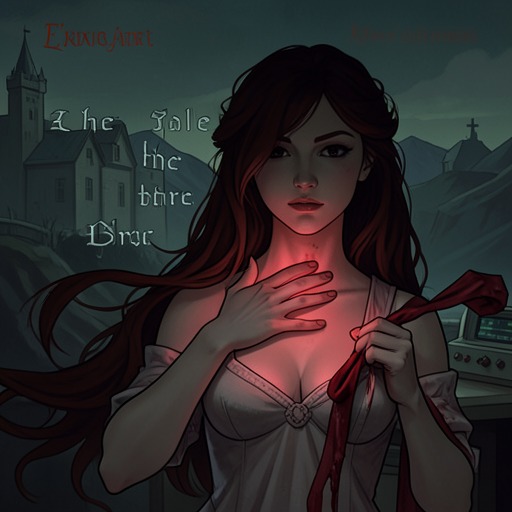
Blood bond to Dracula
The Tale of the Vampire BrideThe blood bond to Dracula is the supernatural basis of Glynis Wright’s captivity: Vlad Dracula’s authority reaches beyond the castle’s walls, constraining her movement, demanding obedience, and shaping her identity as his wife and prospective bride. The bond is not simply a promise of loyalty. Glynis experiences it as a force that can overrule her will, while her resistance exposes the difference between the freedom Vlad sometimes grants and the freedom she seeks for herself.
Nature and Operation
The bond’s coercive power is visible before Glynis understands its full nature. When Vlad demands that she come to him, his words seem to call within her, and her body struggles to rise despite her fear and her father Edric Wright’s refusal to give permission for the marriage. Vlad presents his rule in his country as absolute, claiming power over life and death; the scene makes that political dominion intimate, as Glynis feels it acting upon her own body.
After her transformation, the bond’s restrictions become explicit. When Glynis throws herself from a window in an attempt to escape, an invisible barrier casts her back into the room. Cneajna explains that the Master does not wish the women to leave the castle and that they are bound to him by his blood. She describes him as husband, lover, protector, and keeper, and says that they cannot leave unless he releases them. The bond therefore joins supernatural compulsion to the language of marriage: what Cneajna calls being wives, Glynis experiences as imprisonment.
Vlad’s authority also takes the form of direct commands. He insists that Glynis obey him and forces her into a coffin when she rejects the prescribed sleep of the undead. The bond is thus expressed both as an overarching limit on departure and as an immediate hierarchy in which Vlad claims the right to dictate her conduct. Glynis’s verbal refusal does not remove that power, but it makes clear that submission is not the same as consent.
Captivity, Permission, and Resistance
The bond does not prevent Vlad from allowing Glynis limited movement beyond the castle. When he prepares to take her to Buda, he orders her to wear a veil around Andrew Wright so that her changed appearance will not expose the truth of the supposed carriage accident. He says that in Buda she will be permitted to hunt independently and learn the powers of the night, while also insisting that she must answer the Beckoning whenever he calls. The promised freedom is therefore conditional: Vlad can loosen particular restraints while retaining the power to summon her and define the terms of her life.
The veil makes that condition tangible. Vlad has a dressmaker prepare veils to conceal Glynis’s beauty from Andrew, and she finds the heavy organza and lace irritating. As Andrew’s visit approaches, she realizes that she cannot truly see him through the covering; in frustration, she tears it off and throws it onto the bed. Her clothing becomes one of the everyday means by which Vlad manages her exposure and her relationship with her family. The bond’s control reaches beyond physical confinement into the presentation of Glynis to others.
Her resistance is also inward and practical. Before the transformation, Glynis expresses a desire to live as a woman without the constraints imposed on women. Once a vampire, she recognizes that she has escaped one restrictive society only to find herself enslaved to Vlad inside the castle. She begins thinking in terms of survival and eventual escape, and remembers that feeding on a girl who took her ring brought a rush of power. That recognition does not mean the bond has released her; it shows her trying to understand the powers and compromises available to someone still held within it.
Transformation and the Bound Body
The bond accompanies a physical transformation that makes Glynis newly powerful while also making her more completely subject to Vlad. After waking bloodied and wounded, she wonders how she can have lost so much blood and still be alive. During her later rebirth, wind lifts her above the stone floor, her skin turns white, and her eyes acquire a piercing, nonhuman clarity. Cneajna recognizes that she has become a vampire. The change gives Glynis a new body and capacities, but does not by itself undo the bond that governs her existence.
That contradiction becomes especially sharp when Glynis encounters men who both fear her and desire her. She understands the magnitude of her new abilities as her power envelops her, then kills and feeds on one of the men, feeling the blood renew and empower her. The scene establishes that she can exercise formidable power in the world beyond the castle, yet this growing agency is distinct from freedom from Vlad. Her strength can increase while the blood bond continues to define the limits of her autonomy.
Weakening and Consequence
The bond’s ending is tied to Vlad’s weakening. In the final transfer of power, his blood enters Glynis and his strength fills her; as he grows weaker, she feels their bond growing faint. The movement reverses the relation that had governed her life: the blood that bound her to Vlad now carries his power into her, while the bond itself loses force. Its fading marks a change in the balance between them rather than a simple fulfillment of the freedom Vlad had once promised.
The bond therefore links bodily transformation, marriage, and rule. It explains why Glynis can be sent away from the castle yet remain subject to Vlad, why resistance repeatedly meets supernatural limits, and why her liberation depends on a reversal of the power flowing between them. Its final weakening makes the distinction between being granted permission and becoming free decisive: the former remains Vlad’s choice, while the latter becomes possible only as his hold fails.